
Schoolwide Behavior Management Training That Gets to the ROOT of the Problem
ROOTS is a Practical Schoolwide Behavior Framework Designed to Address Challenging Behaviors and Create Calmer, More Consistent Learning Environments
Student Behavior Is Not Getting Easier
What Schools Are Facing Right Now
Teachers feel emotionally exhausted by constant behaviors
Office referrals continue to increase
Staff responses feel inconsistent from classroom to classroom
Students struggle with regulation and transitions
Consequences alone are no longer changing behavior
Teachers want practical strategies they can actually use tomorrow
Move from reactive discipline to proactive systems that work.
What Schools Are Facing Right Now
Teachers feel emotionally exhausted by constant behaviors
Office referrals continue to increase
Staff responses feel inconsistent from classroom to classroom
Students struggle with regulation, transitions, and engagement
Consequences alone are no longer changing behavior
Administrators are spending significant time responding to discipline issues
Teachers want practical strategies they can actually use tomorrow
That's Why We Created ROOTS Framework
ROOTS was developed by Strobel Education's team of behavior specialists, bringing more than 45 years of combined experience helping schools address behavior challenges, strengthen relationships, and create supportive learning environments.
After supporting hundreds of educators and schools, we recognized a common problem:
Most behavior initiatives focus on isolated strategies instead of the systems that drive behavior across an entire school.
ROOTS was designed to change that. Rather than offering another set of disconnected practices, ROOTS provides a practical schoolwide behavior framework that helps educators create consistency, strengthen relationships, improve regulation, and build sustainable systems that support both students and staff. This is not theory.
It's built from real work inside real classrooms and designed for real-world implementation.
Why the ROOTS Schoolwide Behavior Framework Creates Lasting Change
This Is Not Another Initiative
ROOTS doesn't require schools to purchase another behavior program. Instead, it strengthens the systems, routines, practices, and structures already in place.
The Result?
A practical schoolwide behavior framework that educators can begin implementing immediately.

ROOTS Help Schools:
Create consistency across classrooms
Improve student regulation and engagement
Reduce reactive discipline practices
Strengthen relationships without sacrificing accountability
Increase instructional time
Build sustainable systems that last beyond the training day
What Makes ROOTS Different?
ROOTS is not another behavior program.
ROOTS helps schools build the systems that support:
PBIS
MTSS
SEL
Restorative Practices
Trauma-Informed Approaches
Why Schools Choose ROOTS Over Traditional Behavior Training
Most schools already have pieces of the solution.
Trauma-informed practices.
Classroom management strategies.
SEL initiatives.
Restorative practices.
The challenge isn't a lack of programs. It's that the pieces often operate independently.
ROOTS brings them together into one schoolwide behavior framework.
What Changes When Schools Implement ROOTS
Schools that implement the ROOTS schoolwide behavior framework often experience:

More consistent staff responses

Fewer office referrals

Increased student engagement

Stronger teacher confidence

Better classroom climate

Reduced educator stress

Greater alignment across classrooms

More instructional time
Here’s what teachers and administrators are saying about this workshop:

ROOTS gave our staff a shared language — for the first time, every teacher in the building was responding the same way. Our referrals dropped 40% by the end of the year.
Aubrey
Principal, Elementary School

I’ve been through a lot of PD. ROOTS is different because it doesn’t just tell you what to do — it builds the systems that make consistent behavior possible every single day.
Jonathan
Instructional Coach, K-8 School

Our teachers went from dreading Monday mornings to feeling equipped. ROOTS changed how we see behavior — it’s not a discipline problem. It’s a systems problem.
Mary
Assistant Superintendent
Teachers do not need more theory.
They need systems that work in real classrooms.

MEET YOUR ROOTS BEHAVIOR SPECIALIST
Tomelle Greenfield, M.A., ABA
Tomelle Greenfield developed the ROOTS Framework after two decades inside real classrooms — watching well-meaning schools struggle with the same patterns. She has supported hundreds of educators in building behavior systems that are consistent, compassionate, and sustainable.
When she’s not leading professional development, Tomelle coaches school leadership teams through implementation planning and consults on district-wide behavior strategy.
What Your School Receives

ROOTS Resource Library
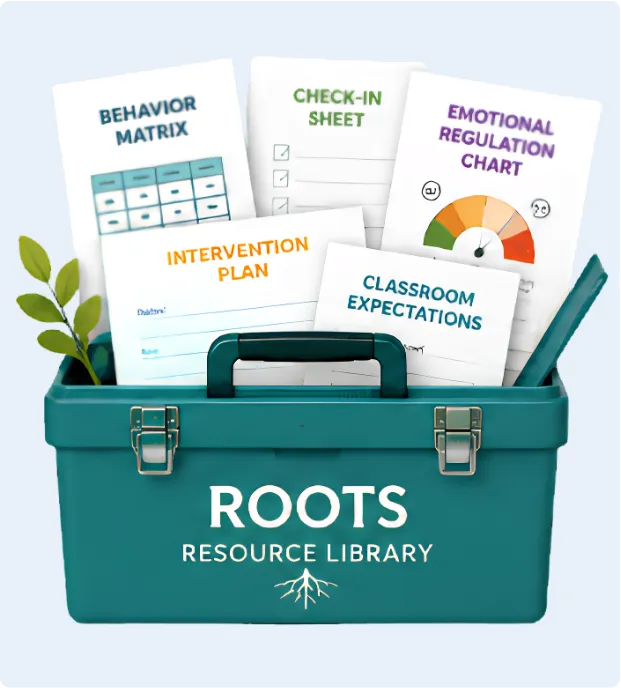
Lifetime access to behavior matrices, emotional regulation tools, check-in/check-out forms, intervention templates, classroom systems, implementation guides, and ready-to-use resources that help educators put the ROOTS Framework into practice immediately.

Implementation Workbook
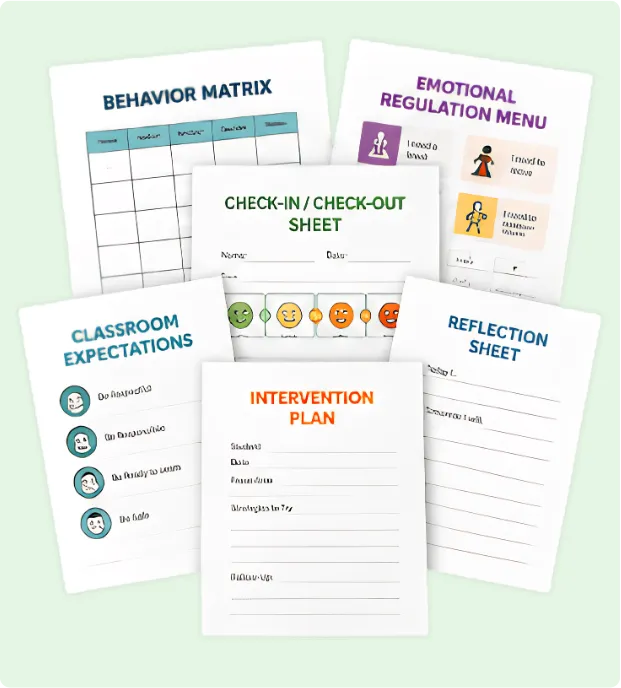
A practical workbook designed to help educators reflect, plan, and apply the ROOTS Framework in their classrooms and schools.

Professional Growth Certificate
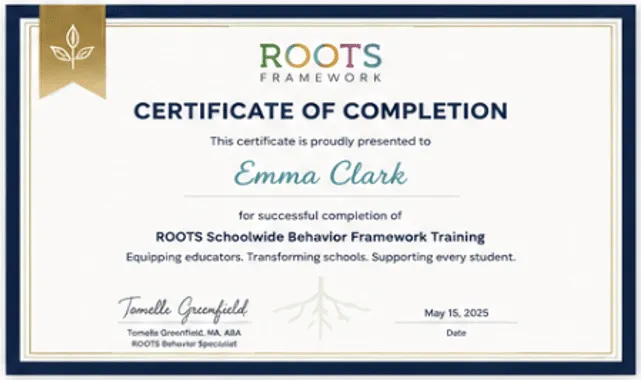
A practical workbook designed to help educators reflect, plan, and apply the ROOTS Framework in their classrooms and schools.
What Your Team Will Learn
The ROOTS Framework provides educators with a practical roadmap for improving behavior, strengthening relationships, increasing engagement, and creating schoolwide consistency.
Each component builds upon the next to help schools create lasting systems that support both students and staff.

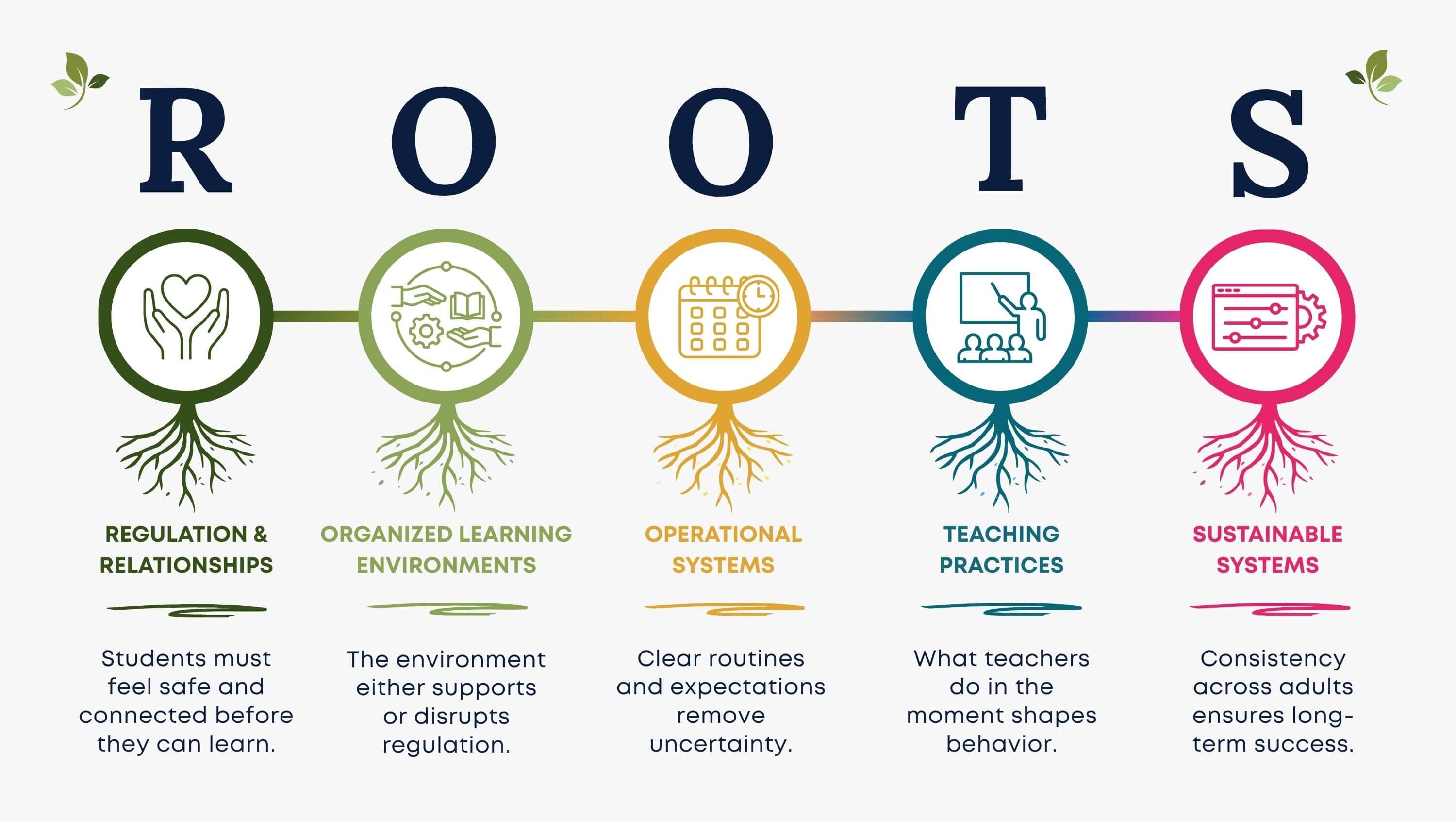
REGULATION & RELATIONSHIPS
Build safety, connection, and co-regulation so students can learn.

ORGANIZED LEARNING ENVIRONMENTS
Design spaces and environments that support regulation and focus.

OPERATIONAL SYSTEMS
Create routines and expectations that reduce uncertainty and guide behavior

TEACHING PRACTICES
Use intentional strategies in the moment that influence behavior and build skills.

SUSTAINABLE SYSTEMS
Build consistency across adults so systems last and grow.
ROOTS Behavior Management Framework
PD Training Schedule
DAY 1: Planting the ROOTS Framework: Regulation & Relationships
Module 1: The Mindset Shift: From Fixing Students to Creating Conditions for Success
The ROOTS framework shifts the focus from “fixing students” to strengthening the conditions that support behavior, regulation, and learning. Participants will explore how adult responses, classroom systems, and schoolwide practices impact student success while building a shared understanding that behavior is communication and proactive systems create safer, more supportive learning environments.
Module 2: The ROOTS Framework for Behavior and Learning
The ROOTS Framework explores how aligned systems create strong classroom and schoolwide foundations for behavior and learning. This framework focuses on Regulation & Relationships, Organized Learning Environments, Operational Structures, Teaching Practices, and Sustainable Systems to support engagement, regulation, and student success.
Module 3: Understanding the Brain: How Stress, Trauma, and Regulation Impact Learning
Explores how the brain responds to stress, safety, connection, and learning while examining how regulation impacts attention, behavior, decision-making, and engagement.
Module 4: R – Regulation: Helping Students Regulate, Reset, and Build Capacity
Regulation and co-regulation play a critical role in student success and classroom functioning. Explores strategies that help students recognize, manage, and respond to emotions in safe and productive ways while creating predictable, calming environments.
Module 5: R – Relationships: Building Connection, Belonging, and Safety
Intentional relationship practices help build trust, belonging, emotional safety, and connection within the classroom community. Explores proactive and restorative strategies that strengthen relationships while increasing student engagement, regulation, and readiness to learn.
DAY 2: Strengthening the ROOTS Framework: Optimal Learning Environments & Operational Structures
Module 6: O – Optimal Learning Environments: Designing Spaces That Support Regulation and Learning
Intentional classroom design directly impacts student behavior, regulation, engagement, and success. Focuses on how physical layout, sensory considerations, organization, and environmental structures create spaces where students feel safe, calm, and ready to learn.
Module 7: O – Operational Structures: Creating Predictable Systems That Support Student Success
Predictable routines, expectations, transitions, and classroom systems help reduce uncertainty, increase independence, and create conditions where students can successfully engage in learning. Learn how consistent structures support regulation, behavior, and student success.
DAY 3: Activating the ROOTS Framework: Core Teaching Practices
Module 8: T – Core Teaching Practices: Responsive Practices That Build Engagement and Momentum
Instructional and behavioral practices play a critical role in keeping students engaged while preventing and responding to challenging behavior in real time. Participants will learn practical strategies that increase participation, maintain momentum, strengthen relationships, and support positive learning experiences for all students.
Module 9: S – Sustainable Systems: Creating Alignment Through Consistent Schoolwide Practices
Consistency across classrooms, teams, and schoolwide systems is essential for sustaining long-term success. Participants will discover how aligned practices, shared expectations, ongoing reflection, and intentional “re-rooting” strengthen outcomes for students and staff over time.
DAY 4: Sustaining the ROOTS Framework: Systems for Success
Module 10: Turning Data Into Action: Using Systems to Support Student Success
Behavior and classroom data help schools identify patterns, prioritize needs, and strengthen proactive systems of support. Examines how office referrals, behavior trends, classroom data, and other indicators can guide decision-making and support meaningful changes that improve outcomes for students and staff.
Module 11: Turning Data Into Action: Using Systems to Strengthen Student Success
Behavior and classroom data help schools identify patterns, prioritize needs, and determine where proactive changes can create the greatest impact. Focuses on how office referrals, parent communication, behavior trends, and other data sources can guide decision-making and strengthen systems that improve outcomes for students and staff.
Module 12: Building Community, Expectations, and Belonging During the First Weeks of School
The first weeks of school set the foundation for relationships, routines, behavior, and classroom culture throughout the year. Focuses on intentional practices that build connection, belonging, and trust through community circles, group plans, relationship-building strategies, and positive family communication. Develop a practical 5-day launch plan while learning how to intentionally “re-root” expectations, routines, and community following breaks and transitions throughout the school year.
Module 13: From Framework to Action: Implementing the ROOTS Action Plan
Building sustainable change requires intentional planning, reflection, and actionable next steps. Focuses on helping teams identify current strengths, prioritize areas for growth, and develop a first-year ROOTS action plan aligned to their goals, systems, and student needs. Participants will begin developing practical steps to implement proactive practices that strengthen behavior, engagement, and schoolwide success.
For students to learn, their brains must be in the right state.
ROOTS is a system that creates those conditions.
Everything we do live inside the ROOTS


Frequently Asked Questions
Why do you call ROOTS a framework?
ROOTS is not a program or curriculum. It is a framework that provides a common language, shared practices, and aligned systems that help schools create the conditions where students and staff can thrive. Rather than adding another initiative, ROOTS aligns research-based practices into one cohesive approach to behavior, learning, and school culture.
How is ROOTS different from PBIS?
PBIS focuses on teaching and reinforcing positive behavior. ROOTS strengthens PBIS by addressing the relationships, regulation, environments, systems, and teaching practices that influence behavior and learning. ROOTS does not replace PBIS—it helps schools create the conditions that allow PBIS to thrive.
Is ROOTS only for students with behavior challenges?
No. ROOTS is designed for all students and all staff. While it supports students experiencing behavioral or emotional challenges, its primary focus is strengthening Tier 1 practices so all students feel safe, connected, engaged, and successful.
What outcomes can schools expect from ROOTS?
Schools often report:
✔️ Increased student engagement
✔️ Stronger relationships and belonging
✔️ Improved classroom climate
✔️ Greater consistency across classrooms
✔️ Increased staff confidence
✔️ Reduced reactive discipline practices
✔️ Stronger MTSS and PBIS implementation
Is ROOTS trauma-informed?
Yes. ROOTS incorporates trauma-informed principles such as regulation, relationships, psychological safety, and understanding the impact of stress on behavior. It also goes beyond trauma-informed practices by providing a comprehensive schoolwide framework for behavior and learning.
Can ROOTS be implemented schoolwide?
Absolutely. ROOTS was designed as a schoolwide framework. While individual educators gain practical strategies, the greatest impact occurs when schools implement ROOTS across classrooms, grade levels, and leadership teams.
How long does implementation take?
Implementation timelines vary based on a school’s goals and level of support. Some schools begin using ROOTS strategies immediately, while others engage in a multi-year implementation process that includes professional development, coaching, and leadership support.
Is coaching available?
Yes. Strobel Education offers coaching and implementation support to help schools move from learning to action. Coaching may include leadership support, classroom observations, implementation planning, and ongoing guidance.
Can ROOTS work alongside our existing initiatives?
Yes. ROOTS was designed to strengthen and align existing efforts such as PBIS, MTSS, SEL, restorative practices, trauma-informed practices, and classroom management initiatives. It does not replace existing work—it helps schools integrate it more effectively.
Ready to Build a Schoolwide Behavior Framework That Works?
Help your educators move beyond reactive discipline and create lasting behavior change.
No commitment required. Just a conversation about your school’s needs.
Keep In Touch


